

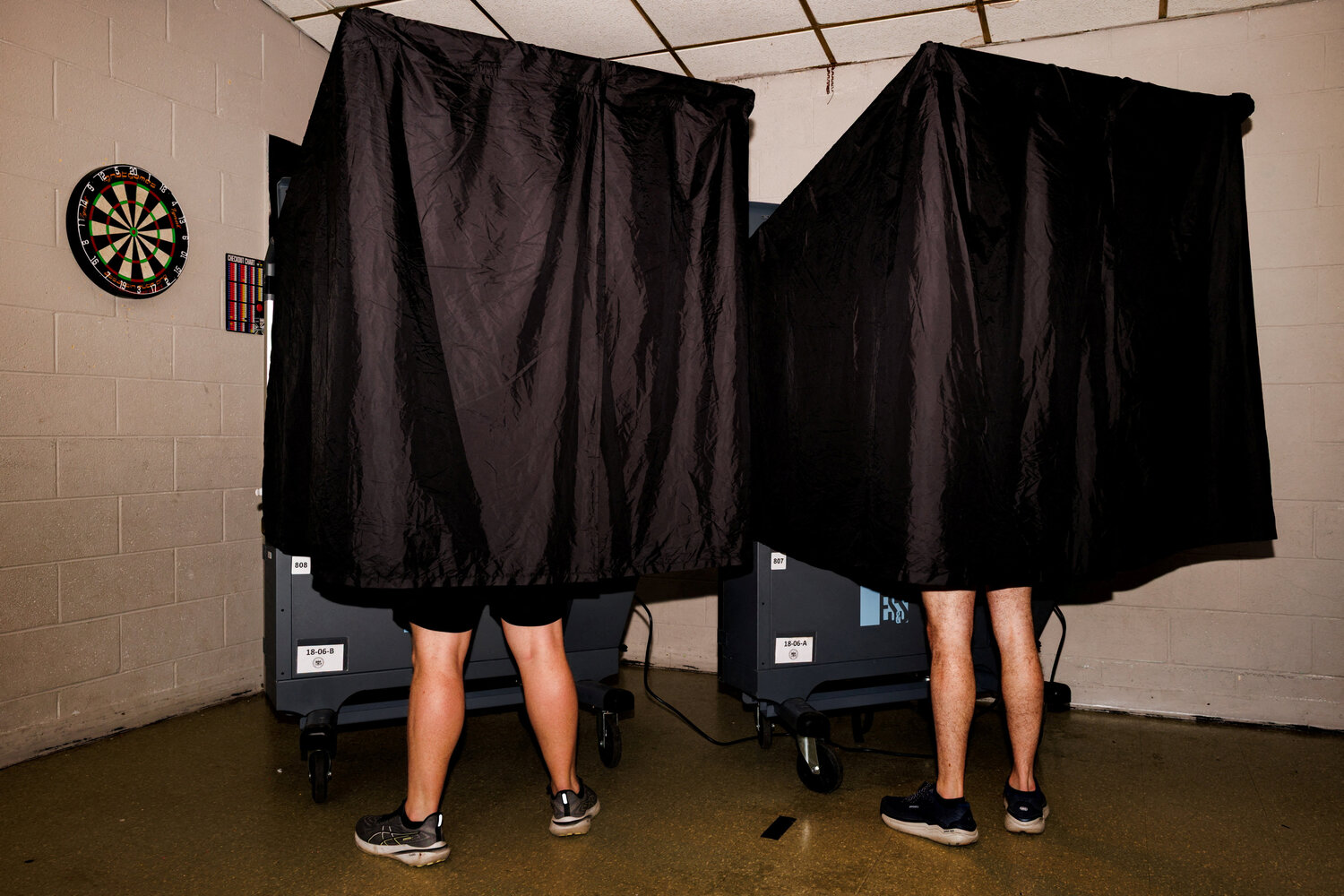


Philadelphia’s primary ballot was light Tuesday, aside from the high-stakes Democratic race in the 3rd Congressional District.
Voters did, however, weigh in on a handful of contested state legislative races, and Pennsylvanians finalized November’s gubernatorial election. City residents also approved a pair of ballot measures.
There was little intrigue in the primary for the commonwealth’s top executive.
Gov. Josh Shapiro, a Democrat, and Republican State Treasurer Stacy Garrity faced no opposition. Their campaigns are expected to heat up in the coming months.
“We’ve gotten a lot of stuff done in the last few years – growing our economy and creating thousands of good-paying jobs, investing in public education and law enforcement, standing up for our freedoms and democracy – but there’s a lot more to do,” Shapiro said in a statement Tuesday night.
Garrity, in a post on Facebook, wrote that it is her “commitment to work every day between now and November’s General Election to defeat Josh Shapiro.”
“Make no mistake: it will take all of us to defeat Josh Shapiro this November,” she continued. “Josh Shapiro has collected millions in campaign contributions from liberal billionaires and he is the darling of the national Democrat establishment.”
On the Republican side, there were two candidates — Jason Richey and John Ventre — vying to share the ticket with Garrity as the lieutenant governor nominee. Richey, who was endorsed by Garrity, won with nearly 66% of the vote, according to unofficial results posted to the state’s website.
Incumbent Lt. Gov. Austin Davis was uncontested on the Democratic ballot.
Chris Johnson, a School District of Philadelphia employee and former staffer for multiple elected officials, emerged in a three-way contest to replace state Rep. Chris Rabb in the Mount Airy-based 200th district. Rabb opted not to run for reelection as he pursued a seat in Congress.
Johnson, who was endorsed by Rabb, took nearly 62% of the vote, compared to 22.5% for Deshawnda “Dr. Dee” Williams and about 16% for Qasim Rashad, according to preliminary results. No Republicans filed to run.
In another three-person Democratic contest, social worker Sierra McNeil pulled in about 53% of the ballots, unseating incumbent Rep. Keith Harris (27%) and beating out Kenneth T. Walker Jr. (19%).
McNeil will have no GOP opposition in November, paving the way for her to represent North Philadelphia’s 195th District.
Incumbent state Sen. Art Haywood easily fended off a challenge from Mike Cogbill in the Democratic primary for the 4th District, which includes sections of Northwest Philadelphia and Montgomery County. Haywood, originally elected in 2014, pulled in more than 85% of ballots, state returns show.
Sen. Anthony H. Williams claimed a similar margin of victory in the Democratic race in the 8th District, where he faced David Goldsmith Jr. The district spans parts of South Philadelphia, Southwest Philadelphia, West Philadelphia and Delaware County.
Regina G. Young and Morgan Cephas, two lawmakers seeking reelection to the Pennsylvania House, gained the overwhelming majority of the vote tally against Joe Sackor and D’Angelo T. Walker Jr. in the 185th and 192nd districts, respectively.
All other Democratic and Republican state legislative candidates were nominated without opposition.
Philadelphians approved two changes to the city’s governing document.
The first establishes a nine-person board to oversee PhillySaves, a program that will automatically set up individual retirement accounts for people without access to such plans through their employer.
For eligible workers, 3% to 6% of their paycheck will be deducted and invested in an account, unless they opt out. City Council officials are hoping to get the program up and running sometime next year.
“PhillySaves is a long-term solution to reduce the retirement savings gap and ensure that our residents can retire comfortably and with dignity,” said Council President Kenyatta Johnson, who introduced the corresponding legislation, in a statement. “This is a very good day for Philadelphia workers.”
The mayor and Council president are tasked with each appointing four members to the board, with the final individual nominated by the City Controller, according to the text of the bill.
Nearly 88% of voters pressed “Yes” for the second question, making the Office of the Youth Ombudsperson a permanent municipal agency.
“Young people in detention, foster group homes, and psychiatric facilities deserve an independent voice for their safety and rights,” City Councilmember Jamie Gauthier, the measure’s primary sponsor, said in a statement. “No one cares about our kids as much as we do, and Philly showed up for them at the ballot box."
The office was established by Mayor Jim Kenney through a 2022 executive order. Its role is to monitor child welfare, juvenile justice, and behavioral health residential placement facilities by responding to complaints, conducting evaluations and educating young people about their rights.


