
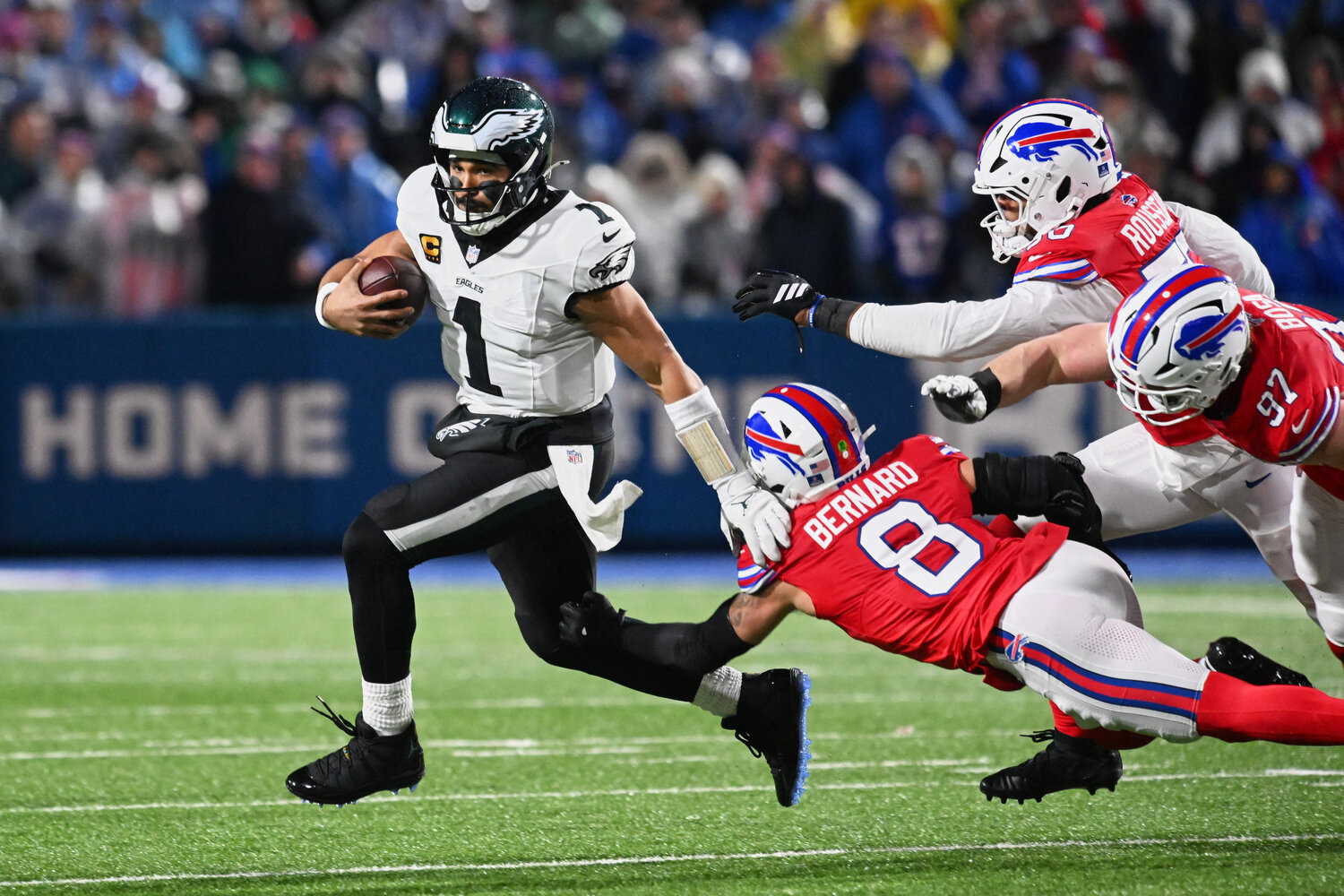
Jalen Hurts has improved significantly as a passer since entering the league, and many factors have contributed to his ascension. To understand his development, you have to understand what goes into every dropback. It is not about arm strength, mobility, or even those beautiful deep balls he throws, even though all of that is important to some degree. It is about understanding the game and how it unfolds in an instant. This is just a small window into the mind of Jalen and every other QB in the league.
There is a lot more to quarterbacking in the NFL than arm strength or athleticism; it’s about reading the defense and having or creating answers. Every defense shows a picture before the snap, then the image changes just as fast when the play is in motion. The great QBs don’t panic when the picture changes; they have built-in, predetermined answers and adjust accordingly. They recognize the defensive alignments and intent and proceed accordingly. For the coordinators on each side of the ball, it’s a mental chess match disguised as a passing game, but the quarterback is the only one who sees the entire board on the field, and the one who has the largest impact on whether a team wins or loses.
Every play starts with a question. The read tells you where to begin, but the defense tries to dictate how it ends. Pre-snap, the quarterback is reading rotation and depth, among other factors. They are trying to confirm what the design suggests.
A common mistake when judging quarterbacks is assuming you know the play design and progression. Quarterbacking isn’t guessing; it's about deciphering and showcasing rhythm and timing. His eyes, feet, and internal clock must all align.
Many QBs, especially early in their careers, bail too early. If they do not like their first read, they immediately look to the other side. That was described to me as the kiss of death. Most concepts give you multiple options on one half of the field; flat, curl, corner, hook, etc, but if you abandon that side too soon, you break the design. Going through the progressions until the structure indicates otherwise is often more successful than resetting mid-progression, as it disrupts timing and most plays.
The real challenge begins post-snap. That’s where the great Quarterbacks separate themselves. Reading defenders' movements and letting coverage reveal where the ball goes is a science. There are options available in every shell that the defense is trying to obscure. Recognize them, and the QB has the answer to where to go with the ball.
The ability of a Quarterback to recognize the defensive plan pre-snap is the difference between a successful and an unsuccessful career. When a QB scans the field and sees a two-high shell, it paints a picture in his mind of what the defense is trying to do. Once the safety moves, the previous image needs to be completely forgotten. The QB needs his eyes to recognize depth and rotational changes in real time. He also needs to know how that reshapes their approach and what he and the offense will do.
There is a window in Cover 2 known as the “honey hole.” This is the gap between the cornerback and the safety. This is created when the safety stays wide, and the corner is flat. If the corner drops back into a deeper zone and the safety rolls over, that window closes as fast as it opened. The QB then typically moves to the opposite side or looks for a pass underneath.
The ‘Tampa’ 2 is a defensive scheme that looks like a traditional Cover 2 shell with two safeties deep, splitting the field, but there are more complexities to it than that. The linebackers sometimes drop deep, making it a quasi Cover 3. The corners jam receivers into the area where help is, and force everything underneath. The alignment requires the safeties to stay disciplined, read the QB’s eyes, and get downhill when the ball is released. The coverage is about narrowing the field, eliminating deep shots and explosive seams, and waiting for the offense to make a mistake.
The Eagles' DC, Vic Fangio, likes quarters, also known as the Cover 4 shell. Effective and much different than Cover 2. Both safeties remain deep in coverage and are each responsible for a quarter of the field, as are each of the two corners, hence the name. The alignment can look like Cover 2 pre-snap, but as the play unfolds, the safeties read the inside receivers and shift accordingly. The dig route and the open post disappeared because the vertical routes covered them.
Another mid-play modification occurs when the two high shells morph into Cover 3 Cloud. This closes the middle of the field and erases the aforementioned honey hole. The QB must react again and read the curl in the flat, among other things. The successful QBs ignore the disguise and react to the play's structure. They are not reading coverage; instead, they are trying to mold it with a glance to freeze a defender and create space elsewhere. They are trying to use their eyes to disguise their intentions, just as the defense is hiding its own.
Every coverage leaves something open, and it's the QB's job to find it.
Slant: Sprint forward for a few steps, then make a sharp cut inside towards the middle of the field. This is effective when a defensive back is playing off the receiver.
Out: Run straight upfield, then break sharply towards the sideline.
Dig / In: Run downfield, typically 10 to 15 yards, and then cut inside towards the middle of the field.
Go / Fly: A straight sprint downfield towards the end zone. This route can be used to either gain a lot of yards or to draw defenders away from other receivers.
Post: Run deep and then angle the route towards the goalposts.
Corner: Similar to a post route, but the receiver angles towards the corner of the end zone near the sideline.
Comeback: Run deep, then stop and turn back towards the quarterback, creating separation near the sideline.
Curl / Hitch: Run out a short distance, usually five to ten yards, stop, and turn back towards the quarterback.
Out-and-Up / Double Move: Fake a short out route, then quickly turn and run upfield for a deep pass.
Wheel: The receiver runs towards the sideline, then turns and runs upfield along the sideline.
When evaluating a quarterback's play, knowing the difference between progression and panic is key. A checkdown pass should not be viewed as a sign of panic; they are typically built into the play's design. When a running back or tight end gets a free release, it is part of the quarterback's job and progression to utilize that option. He has to ascertain what the defense is giving him and make these throws. In short, you have to trust the coaching and the play design. When there is a disconnect here, there will be major offensive issues.
For Quarterbacks, timing is everything. You have to be able to do more than throw a receiver open; you have to anticipate the window and let it rip. The defense could rotate and get an interception, but that comes with the job. Waiting too long causes sacks and numerous other issues, and it will likely cost you more plays than being too conservative ever saves.
Someone once said, “Throwing too many picks is a problem. Not throwing any is a problem, too.” I do not remember who said it, but it rings true. Quarterbacking at this level is about balance and structure before the snap and processing everything that changes after it. Your arm and accuracy get you in the NFL. Vision, timing, and evolving into a better QB keep you there.
That’s the line between a thrower and a quarterback, as described to me through my crash course with a former NFL scout, years ago.
As always, thank you for reading!
Follow me on X @DavidNeiszPHL


