
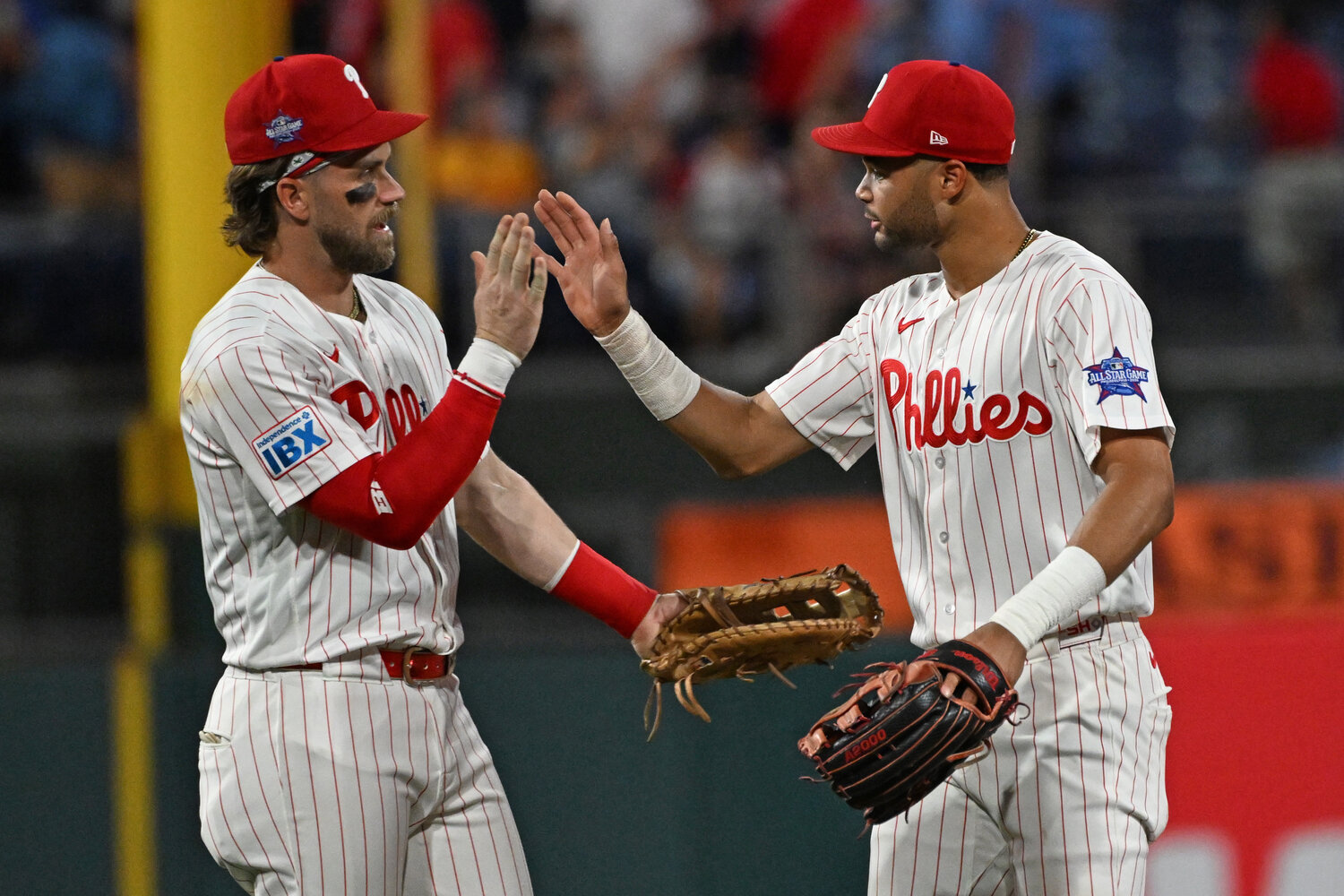
Other than the Los Angeles Dodgers, no team in baseball has older hitters than the Philadelphia Phillies. The lineup is powered by a core of aging veterans: 33-year-old Bryce Harper, 35-year-old J.T. Realmuto, 33-year-old Trea Turner, and noted speedster 33-year-old Kyle Schwarber.
But to look at what Philadelphia has done on the basepaths this year, you could be tricked into thinking that the Phillies were a fleet-footed squad of aggressive youngsters. They lead the league in stolen base success rate and place second in Statcast baserunning runs behind the Miami Marlins, the league’s third-youngest lineup.
There’s a discrepancy here. Older teams are typically slower, but the Phillies’ aging squad has shown no signs of slowing on the basepaths.
“I tell a lot of guys, when you're not going on this certain pitch, you're still looking for the ball in the dirt. You're still looking to beat the force at second. You're still looking at a line drive [with] less than two outs. Are you getting back? Are you able to read a fly ball and tag to advance an extra 90 feet?” said Phillies baserunning coach Paco Figuroa on an episode of Phillies Extra.
It’s the little things he mentioned that have kept the older, slower baserunners from holding the team back.
But helmed by Bryson Stott, Trea Turner, and Brandon Marsh, the Phillies have a stable of players that continue to push the envelope as baserunners.
MORE: Phillies’ offense cools off as bullpen drops game to Pirates 6-1
Since coming into the league in 2022, Stott has been a revelation on the basepaths. His successful stolen base streak stretches all the way back to September 14, 2025. He ranks fifth among all players league-wide in Statcast baserunning runs, and he’s been adept at taking the extra base in addition to stealing bags.
But more difficult to quantify is the value derived from the influence of a baserunner’s speed on a ball in play.
“When you think about speed, you think about stolen bases, and of course, this game is exciting when you do steal bases; we have players that do so,” Figuroa said. “But our main thing is to apply that pressure in other areas in the game.”
Statcast lists Justin Crawford as having contributed 0 baserunning runs; Fangraphs, 0.8. Nevertheless, he leads the league in infield-hit rate at 13.6% (min. 250 PA). One of those infield hits resulted in a walk-off against the San Francisco Giants on April 30.
You could say it’s Crawford’s 95th percentile speed that allowed him to beat those hits out. You could also contribute it to defenses’ fear of Crawford’s speed. Players rush more, shift differently, make more errors when they know they have less time to make a play.
That fear won Turner a batting title in 2025 when he led qualified hitters in infield-hit rate. Now, with two of the league’s fastest players in the everyday lineup, the Phillies are creating as much havoc as they have since the days of Davy Lopes.
When Lopes joined the Phillies in 2007, he inherited a squad that already had tremendous speed. Jimmy Rollins and Shane Victorino would steal 30+ bases a combined 13 times in their careers, while Chase Utley and Jayson Werth would each become among the most efficient basestealers of their generation.
From 2007 to 2010, Philadelphia led the majors in stolen-base percentage every year, setting an all-time record of 87.9% in 2007. The 2026 iteration of the squad has an 85.9% success rate. Good baserunning is institutional in the Phillies organization.
For players with a minimum of 100 stolen base attempts, Stott ranks third in career success rate; Utley ranks 4th, Turner 10th, Werth 13th, Victorino 30th, and Rollins 49th. In fact, no player in league history has a better success rate on more steals than Utley, who has 176 attempts, or Turner, with 386 attempts.
But it's not just the base stealers that put Philadelphia above most of MLB. The elder statesmen of the Phillies roster are helping on the basepaths, too. The team’s worst baserunners are Schwarber, Harper, and Alec Bohm. Their task is less flashy than the team’s young speedsters, but no less important. Together, they combine for only -3 baserunning runs.
Defense wins championships, we’re told. Well, the Phillies' slowest runners are playing fantastic defense on the basepaths; they’re not running into outs. Even Harper, who Statcast classifies as the worst baserunner on the team by a narrow margin, has equaled his value in extra bases taken and extra bases thrown on.
“He gets on base" was Peter Brand’s reasoning in Moneyball to justify the 2002 Oakland Athletics acquiring unwanted players. Just as important for the Phillies in 2026 has been staying on base.


