




Phillies free agents Kyle Schwarber and Ranger Suárez officially declined their $22 million qualifying offers on Tuesday, Major League Baseball announced, setting up a pivotal offseason for Philadelphia. The pair were two of 13 players across the league to receive the one-year qualifying offer and will remain free agents.
Since both Schwarber and Suárez are looking to sign multi-year high-yield contracts this offseason, the decision is as expected in Philadelphia. Only four players — Trent Grisham, Gleyber Torres, Brandon Woodruff and Shota Imanaga — accepted a qualifying offer this year. The seven additional players to decline their qualifying offers are: Bo Bichette, Dylan Cease, Edwin Díaz, Zac Gallen, Michael King, Kyle Tucker, and Framber Valdez.
The qualifying offer has been a part of baseball since the 2012 Collective Bargaining Agreement. Essentially, if a player is entering free agency, a team can make a “qualifying offer” for a one-year contract based on the mean of the 125 highest-paid players in the league. For 2026, that mean value was $22.025 million.
An individual player may only receive a qualifying offer once for the entirety of his career and a team can only give an offer if the player spent the full season with that organization. 157 players have received a qualifying offer since 2012, with only 18 of them having accepted the offer. Even by today’s standards, that .115 batting average shows how rare a qualifying offer is accepted.
Then why do teams even bother with qualifying offers? To get compensated if they cannot retain their free agent. Should a free agent decline a qualifying offer and then sign with a different organization, the team receives draft pick compensation in the following year’s MLB Draft. The value of the draft pick is determined by a tier system based on whether the organization pays or receives Competitive Balance Tax money. For the Phillies, a team that plays into the tax, they would receive a compensation pick after the fourth round should they fail to re-sign either Schwarber or Suárez. If both players are re-signed? No harm, no foul, no draft pick.
There also exists a similarly tiered system for penalizing teams that sign another team’s qualified free agent. For the Phillies, should they sign a qualified free agent like Tucker or Bichette, the Phillies would lose their second and fifth-highest draft picks in the 2026 MLB Draft and $1 million in their international bonus pool for the next signing period. If they then sign a second qualified free agent, they would then forfeit their third and sixth-highest picks as well.
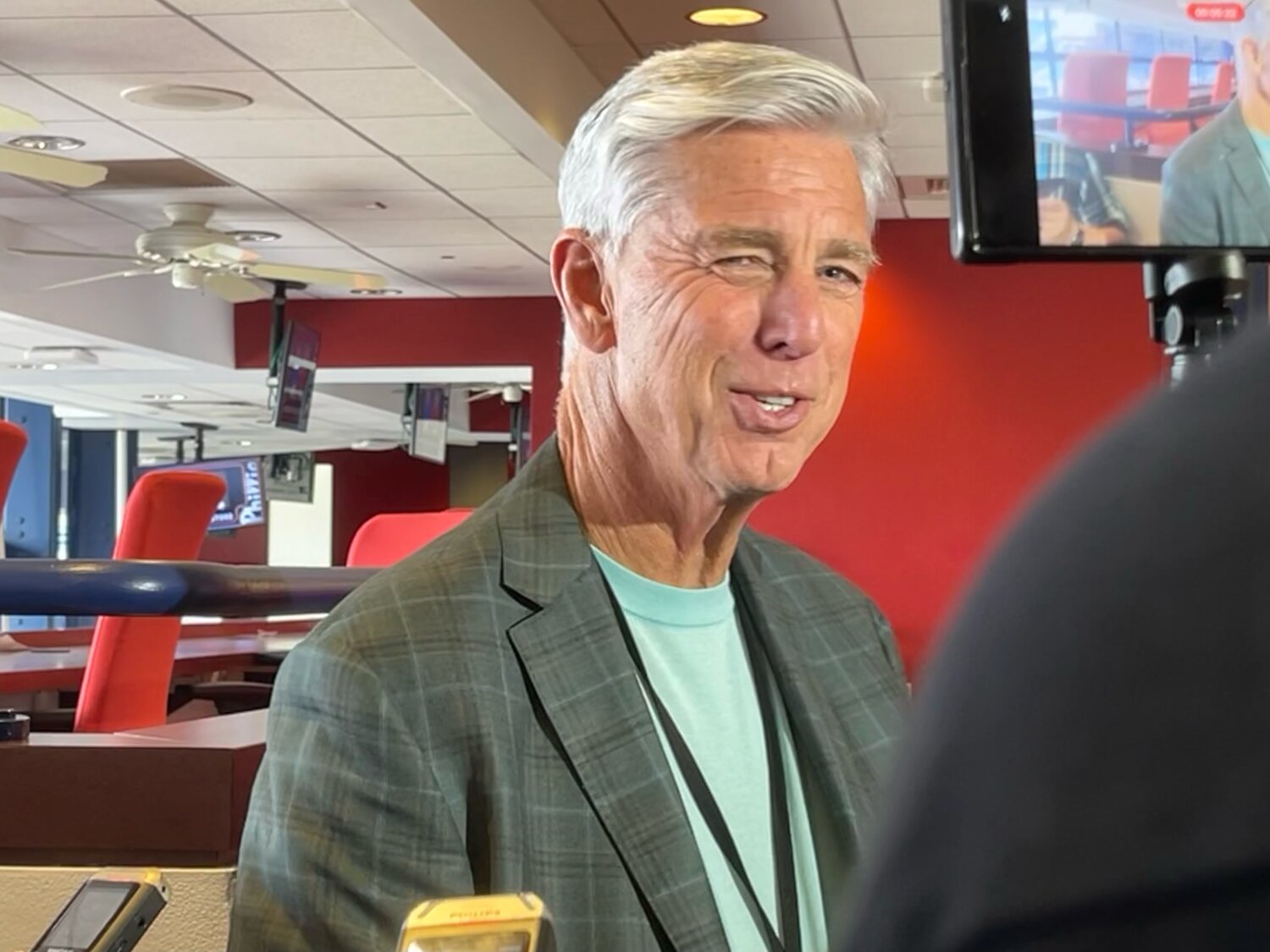
Phillies president of baseball operations Dave Dombrowski made it clear last month that the club will attempt to re-sign Schwarber and Suárez, along with J.T. Realmuto and Harrison Bader. Schwarber remains the top priority, although he is expected to be one of the most sought-after bats on the market. Recent reporting has linked the Pittsburgh Pirates to the All-Star designated hitter. After hitting 56 home runs and finishing second in the National League MVP race, Schwarber’s market will be aggressive, and the Phillies will need to be competitive if they hope to retain their cornerstone slugger.
Suárez’s status is more complicated. While the Phillies value him highly, the left-hander is not as essential to their 2026 roster construction as Schwarber may be. Zack Wheeler is expected to return, Andrew Painter is projected to debut early in the season, and Cristopher Sánchez, Jesús Luzardo, and Aaron Nola give Philadelphia a strong rotation core. Taijuan Walker is also under contract and should again move between the rotation and bullpen. Factoring him in, the Phillies may already have a full starting staff when they report to Clearwater, which could shape how aggressively they pursue a reunion with Suárez.


