

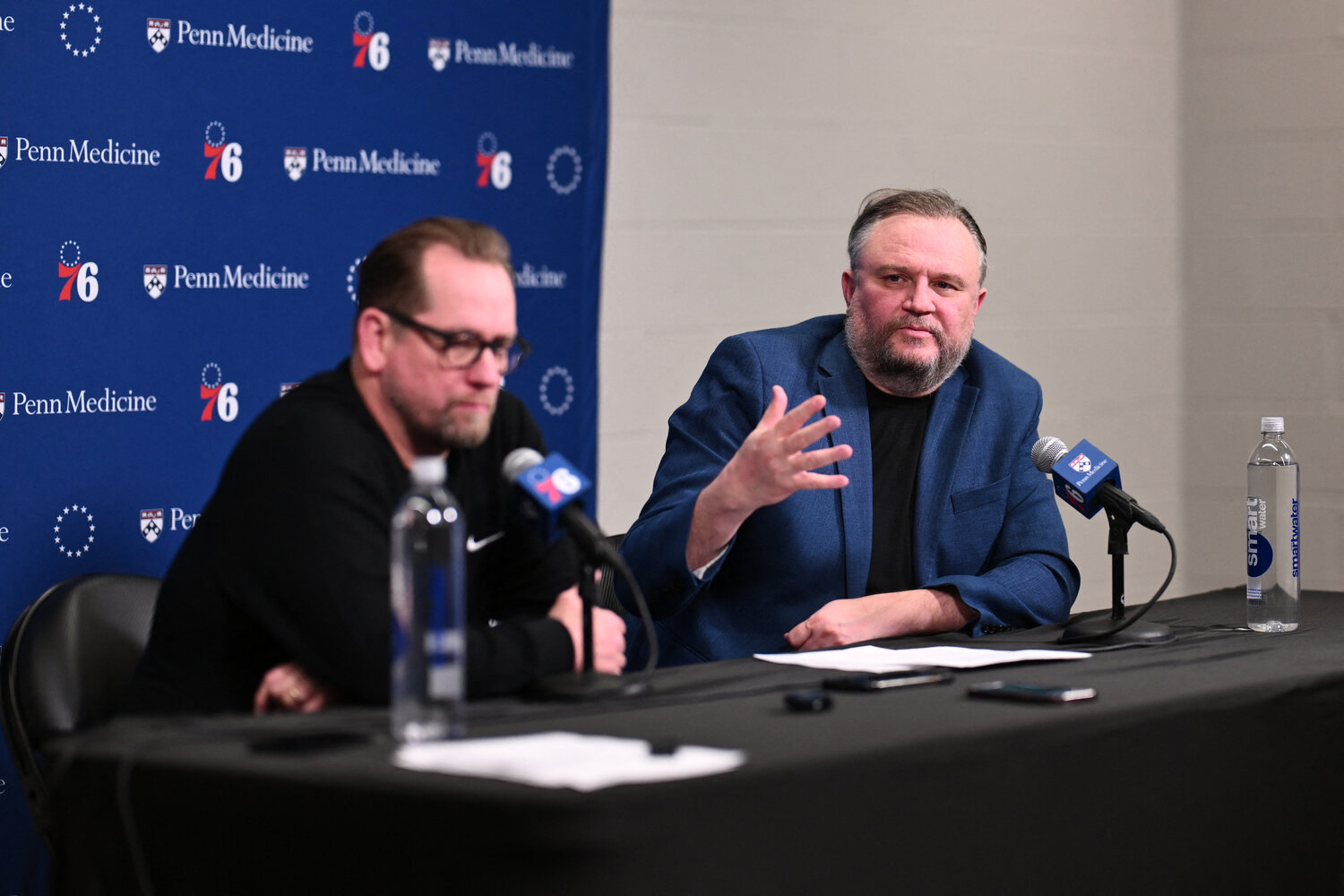


The Sixers made headlines for all the wrong reasons Saturday as it was announced that nine-time All-Star forward Paul George had been suspended for 25 games for violating the League's anti-drug policy. While there is very little to be gained from such a situation, there is a financial component that could benefit the Sixers in a number of ways as the team inches closer to the NBA trade deadline.
Shortly after the suspension, the Third Apron's Yossi Gozlan acknowledged that Paul George's suspension would cost him $11.7 million. In turn, the Sixers are set to receive a tax variance credit of $5.8 million, bringing the Sixers to roughly $1.3 million above the tax line.
Now, what exactly does this all mean?
The NBA's luxury tax is a financial penalty paid by teams that exceed the pre-set, annual tax threshold for their total roster payroll. This season, that number is set at $187.9 million. Each dollar spent above that threshold is taxed at a rate, with half of the tax paid to the league itself, and the rest divided equally among the teams below the luxury tax line.
On the surface, it's easy to see why a team would prefer to avoid paying the tax when they can, especially considering the repeater tax, which increases the tax rate for teams that have crossed the tax threshold in three of the previous four seasons.
Typically, teams are willing to pay the tax, at least for a year or two, if they feel they can contend for an NBA championship that season.
The Sixers have not paid the tax since the 2019-2020 NBA season, the year before Daryl Morey was hired as president of basketball operations.
This year, the Sixers found themselves in a particularly precarious position as the only realistic way they could duck the tax this season would be by trading away a more important player than is often dealt in a salary dump. The most commonly mentioned name regarding this topic was veteran wing Kelly Oubre.
Trading Oubre, who is in the final year of a deal that pays him $8.3 million, would have instantly brought the Sixers below the tax threshold, depending on the salary they took back, if any. Factor in a potential trade of veteran center Andre Drummond's $5 million salary, and the Sixers would be well below the threshold with plenty of funds to convert both Dominick Barlow and Jabari Walker to standard deals while potentially being able to add a player or two via the buyout market as well.
The primary issue is that the odds of any of those players having the positive impact Kelly Oubre has are effectively zero. Oubre has averaged 14.0 points and 4.4 rebounds this season while shooting career-highs in field goal percentage (49.2 percent), three-point percentage (36.5 percent on 4.6 attempts per game), and true shooting percentage (60.0 percent, the third highest among qualified Sixers), all while playing a swiss-army-knife role and providing engaged, tenacious defense.
One cannot simply salary dump Kelly Oubre to duck the tax. However, after Paul George's suspension, the Sixers no longer have to.
As previously stated, the Sixers will incur a tax variance credit of $5.8 million as a result of George's suspension, bringing them to just $1.3 million above the tax line. By trading away Andre Drummond, which multiple sources have expressed the team is expected to do by the trade deadline, the Sixers—again, depending on what salary they take back—will be able to clear enough room to convert Barlow and Walker, with some money to spare against the tax.
Recently, Joel Embiid voiced his desire for the Sixers to maintain their core, if not improve, at the deadline, rather than duck the tax—the term he twice used to describe their deadline habits. However, with this tax variance credit, the Sixers could duck the tax by simply trading away Eric Gordon and his $2.3 million salary, which would allow them to both retain Drummond and convert Barlow to a standard deal, though they would be just over $100,000 away from the tax, likely a bit too close for comfort.
Additionally, the team could opt to still move Drummond while bringing in a player who makes less than Drummond's $5 million salary. Either a young cost-controlled player or a veteran—likely on an expiring deal. The retention of Oubre, along with the potential issue of a young or better-fitting piece, could be enough to both satisfy Embiid and successfully duck the tax for another year.
For the first time all season, the Sixers truly seem to have options at the trade deadline.


