
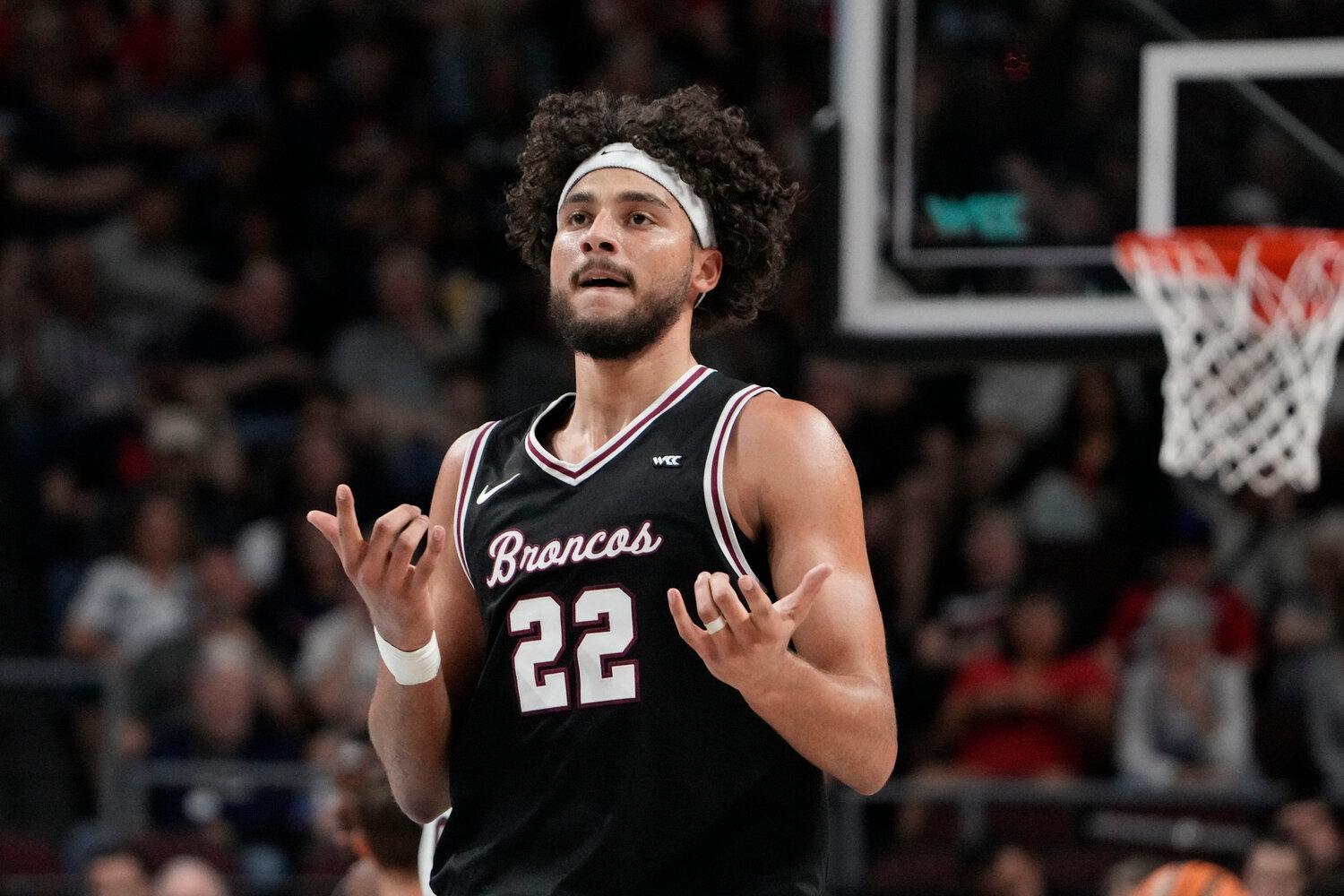
The Philadelphia 76ers are in need of an impact addition with the No. 22 pick in the 2026 NBA Draft and Allen Graves is an intriguing possibility reminiscent of two former Sixers.
After acquiring the No. 22 pick from the Oklahoma City Thunder ahead of the trade deadline, the Sixers are looking to add a young building block, one who can develop alongside Tyrese Maxey and VJ Edgecombe. Santa Clara forward Allen Graves is among the players expected to be drafted around the early to mid-20s, but who is he, and how would he fit the Sixers’ current direction?
A number of Sixers fans may write Graves off, or at least collectively roll their eyes, simply hearing that he’s a favorite among the analytics crowd, but his potential and skill set stand out for good reason.
Graves measured in at 6-foot-7.75 (barefoot) at the Draft Combine, living up to his advertised 6-foot-9 listing. With a 7-foot wingspan and 8-foot-10.25 standing reach, Graves provides size and knows how to leverage his natural advantages to help mitigate what he lacks in vertical and lateral athleticism.
A highly efficient shotmaker, Graves has an intriguing combination of off-ball instincts and a soft touch on shots in and around the basket. Averaging 11.8 points per game, Graves was highly efficient, shooting 51.2% from the field and 41.3% from three on limited attempts, just 8.1 attempts from the floor and 2.6 attempts from deep each night. The volume would ideally increase at the NBA level, but more important is Graves working on quickening his release, which will impact how effective he will be at getting shots off against higher-level athletes.
On both ends, but particularly on offense, Graves positions himself well for rebounding opportunities. He averaged 6.5 rebounds (2.8 offensive) per game last season, utilizing his high motor and court awareness to secure second possessions and create additional scoring opportunities.
Graves also showcased defensive skills off-ball, disrupting passing lanes and operating as a weakside rotation defender and shot blocker. Averaging 2.8 combined blocks and steals per game, Graves paired his impressive measurements with quick instincts to help offset some of his athletic limitations. For his defensive strengths, Graves also has a tendency to get into foul trouble, a signal of his inexperience and something he’ll have to clean up at the next level.
Though he started just four of 35 games and played out of position at Santa Clara, often in the role of the team’s backup center, Graves was able to keep up on both ends, showing tremendous feel for the game, though that’s not to say he’s a finished product.
There are questions around the level of competition Graves played against, but he held his own against ranked competition, averaging 13.8 points, 7.0 rebounds and a combined 2.4 blocks and steals per game. His efficiency dipped from the field and three against stiffer competition, a fact worth noting, but far from a surprise considering Graves is more of a connective player than a shot creator. That lack of creation limits Graves’ potential role and ceiling, but it’s that connective ability that makes Graves a particularly interesting fit in Philly.
Graves’ ability to play off-ball on both ends is an immediate compliment for Philadelphia. The Sixers often run two primary offensive looks, either operating through Joel Embiid and Tyrese Maxey, running actions at the elbow and above the three-point arc, or running high-low post-up looks for Embiid. In either case, Graves can be a complementary cog in the offense.
When Embiid is off the court, Graves can operate as the screener in various actions at the top of the key and beyond the three-point line. His off-ball movement and cutting ability would also allow for Graves to find success when Embiid looks to pass off to an open shooter or cutter when doubled.
Defensively, Graves is nearly everything head coach Nick Nurse looks for, despite his lack of athleticism. His ability to defend passing lanes and opportunistically force turnovers would help the Sixers push the pace and create scoring opportunities, a frequent focal point for Nurse.
The Sixers have seen players with similar skillsets to Graves even in recent years. The primary two who are top of mind are Nic Batum and Robert Covington.
Batum was a very different player in his early years, but as he grew more experienced, his game evolved, helping him become a high-end support player as a low-usage floor-stretching defender and slot connector.
Covington’s NBA journey was far different than Batum’s, but he ultimately found himself more apt as an elite-level defender, particularly off-ball. He also grew into a reliable three-point shooter, becoming one of the league’s premier two-way role players, even twice finishing in the top 10 in Defensive Player of the Year voting. Of the two, Graves shades more so towards Batum, but as a defensive playmaker, he can reach Covington's levels of off-ball defense, even if he proves a lesser on-ball defender than RoCo.
The player that Graves is to become will be decided by his improvement as a three-point threat and continued ability to leverage his measurements and IQ over his athletic challenges. If he can manage that, there could be a 10-plus-year career in store for him.
Graves is unlikely to be a superstar, perhaps not even an All-Star, but he fits the Sixers in as many ways as can be expected from a rookie. As odd as it may sound, he may be the closest the Sixers can get to replacing some of the shooting and off-ball play they lost trading away Jared McCain, while adding a bit more size and being a more complementary defensive fit.
MORE: Sixers mock offseason: A new path forward for Philadelphia


